Accessibility Roles for Researchers
As a researcher, you play a key role in making your work accessible to a wider audience. From data and visualizations to publications and presentations, how you share your findings impacts who can engage with them. This page brings together resources to help you create, review, and improve accessible research content.
General Accessibility for Researchers
- Creating Accessible Documents
- Making Word Documents Accessible
- Make PowerPoint Documents Accessible
- Making Zoom Meetings Accessible
Researcher Specific Accessibility
Use Transcripts to Better Describe Complex Visuals
A simple accessible document transcript that describes in detail the nature of your work that would be available for screen readers is the best way to ensure your content is fully compliant according to WCAG 2.1 standards. Two things to include are:
- alternative tags for your diagram or complex visual
- accompanying accessible pdf transcript describing the visual in more detail for your target audience that may use assistive technologies.
Following is an example of some research webpage copy, its compatible diagram, and the accompanying link to the accessible PDF transcript.
----------------
Pyrimidine base hypermodification
The DNA nucleobases define the genetic code, but there are many intricate modifications that affect their access and function. Termed epigenetic modifications, we are excited to explore enzymes from bacteriophage that generate chemical modifications of pyrimidines. We are specifically looking at a modification pathway that begins with incorporation of 5-hydroxymethyldeoxyuridine (5hmdU) within the DNA fiber. This modification pathways echoes our interest in natural product biosynthetic pathways, in that it is a modular pathway in which different enzymes have roles to chemically activate, modify, and tailor pyrimidine hypermodifications, all within the intact DNA fiber.
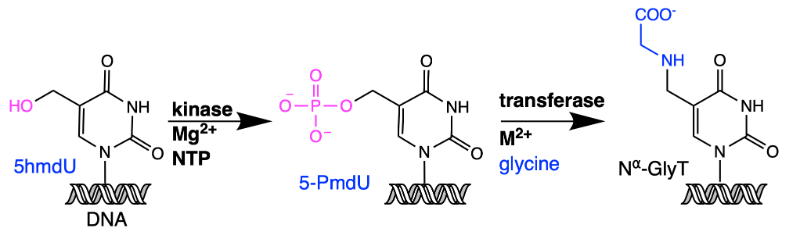
Transcript 5hmdU hypermodification within double-stranded DNA activation and group transfer